Taylor AI
Taylor AI is a platform designed for engineers to easily train and manage open-source language models.
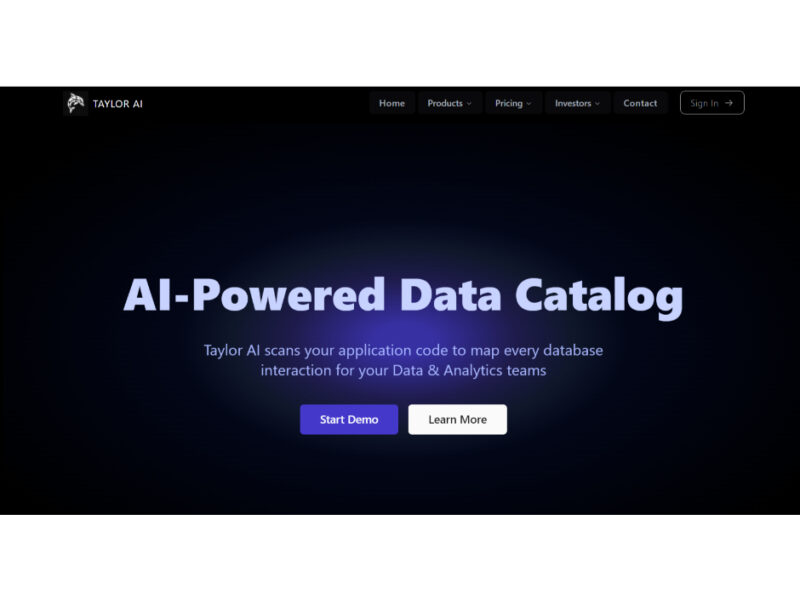
About Taylor AI
Use Cases
Use Case 1: Automated Support Ticket Categorization and Routing
Problem: Customer support teams often face a high volume of unstructured tickets, leading to manual sorting delays, inconsistent tagging, and slow response times for critical issues.
Solution: Taylor allows teams to build a custom taxonomy to classify incoming freeform text automatically. By setting confidence thresholds, the system can reliably categorize tickets into specific buckets (e.g., "Billing," "Technical Bug," "Feature Request") and route them to the correct department immediately.
Example: A user sends an email saying, "I can't log in and my subscription renews tomorrow." Taylor identifies the categories "Authentication" and "Billing," then triggers an automated workflow to prioritize the ticket for the technical support lead and the billing department.
Use Case 2: CRM Data Enrichment from Sales Notes
Problem: Sales representatives often enter detailed but unstructured notes into CRMs after calls. This valuable data remains "dark" because it cannot be easily queried or used for automated reporting on competitor trends or common deal blockers.
Solution: Taylor can be integrated with a CRM to extract specific metadata from freeform sales notes. It transforms messy text into structured fields, identifying key entities like competitor names, specific product interests, or budget mentions.
Example: A sales rep logs: "Client is interested in the Pro plan but mentioned they are also looking at [Competitor Name] because of their API speed." Taylor extracts the competitor name and the "Speed" concern, automatically updating the CRM's "Competitor" and "Risk Factor" fields.
Use Case 3: Scalable Content Moderation for Community Platforms
Problem: Growing online communities generate massive amounts of user-generated content that must be monitored for policy violations. Relying solely on humans is unscalable, while standard LLMs can sometimes be too "black box" or inconsistent for strict moderation rules.
Solution: Using Taylor’s "deterministic way to wrangle text," developers can build high-accuracy classification models for moderation. It provides total control over the labels and thresholds, ensuring that content is flagged or removed according to the platform's specific community guidelines.
Example: A user posts a comment on a forum. Taylor’s bulk classification engine checks the text against a taxonomy of "Spam," "Harassment," and "Self-Promotion." If a post exceeds a 98% confidence threshold for "Spam," it is automatically hidden and logged in a moderation dashboard.
Use Case 4: Structuring Product Feedback for Engineering Roadmaps
Problem: Product managers collect feedback from various sources—App Store reviews, Slack channels, and survey responses. Manually reading thousands of comments to find actionable insights for the engineering team is time-consuming and prone to bias.
Solution: Taylor can process bulk unstructured text to extract specific feature requests and bug reports. By structuring this data, product teams can turn qualitative feedback into quantitative data, seeing exactly which features are being discussed most frequently.
Example: A product team uploads 5,000 recent App Store reviews. Taylor extracts "UI/UX" as the primary category for 40% of the reviews and identifies "Dark Mode" as a specific requested feature, allowing the team to justify the development effort with hard data.
Key Features
- Bulk classification and extraction
- Deterministic unstructured text wrangling
- Custom taxonomy and labeling
- Configurable model confidence thresholds
- Real-time data pipeline integration
- Automated metadata enrichment
- Built-in model testing environment
- Direct CRM and Slack connectivity
Similar Tools You Might Like
Discover more tools in the same category
ReliableGPT
ReliableGPT is a robust and innovative tool designed to enhance the stability and reliability of …

Opera One Browser
Opera One is a next-generation browser that emphasizes a liquid navigation experience. It stands out …

MindStudio
MindStudio by YouAi is an innovative platform that enables users to create personalized AI applications …
Live Preview:
Updates automatically with live stats
Copied to clipboard!