Tafi Avatar
Experience the revolutionary Text-to-3D Character Engine that brings your words to life! Create dynamic and captivating characters with just a few simple commands. Say goodbye to boring and static text …
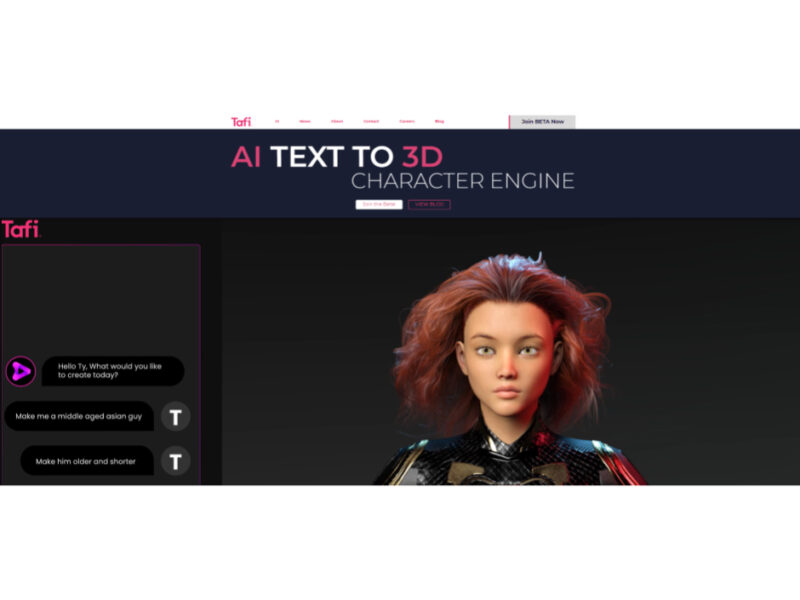
About Tafi Avatar
Use Cases
Use Case 1: Scaling Synthetic Datasets for Human Pose Estimation
Problem: Training AI models to recognize human movement (computer vision) requires massive datasets of diverse people in various poses. Collecting real-world photos is expensive, fraught with privacy concerns, and lacks precise "ground truth" labels for joints and topology.
Solution: Tafi Avatar provides topology-consistent 3D characters with semantic labeling and metadata. Because every character shares the same base mesh and vertex count, developers can generate thousands of unique individuals (different ages, ethnicities, and body types) while maintaining perfect data alignment for the AI to learn anatomical deformation and movement.
Example: A developer building a remote physical therapy app uses Tafi to generate 5,000 unique synthetic avatars. They use these models to train their AI to identify correct joint alignment during squats, ensuring the app works accurately for users of all body shapes without needing to film thousands of real people.
Use Case 2: Automated NPC Generation for Large-Scale Game Worlds
Problem: Creating a diverse population of non-player characters (NPCs) for open-world games or simulations often leads to "clone" characters or requires massive manual effort from 3D artists to rig and skin each unique model.
Solution: Tafi’s parametric character generation allows for near-infinite variations from a unified system. Since assets like clothing and hair are "legacy-ready" and auto-fit across different morphs, developers can procedurally generate an entire city’s worth of unique citizens that are already rigged and ready for Unreal Engine or Unity.
Example: An indie game studio uses Tafi’s API to procedurally generate 200 unique shopkeepers and pedestrians. Because the assets use a consistent edge flow and rigging system, the studio applies a single set of walking animations to all 200 characters instantly, saving months of manual technical art labor.
Use Case 3: Training AI for Virtual Try-On and Garment Physics
Problem: E-commerce companies want AI that can accurately predict how clothing will drape and move on different body types. However, teaching an AI to understand the complex relationship between fabric physics and human anatomy requires data where the clothing and the body interact realistically across thousands of variations.
Solution: Tafi offers dynamic clothing and hair simulation that conforms to any character morph. This teaches AI models to interpret garment behavior and physical responses across a spectrum of anatomical shapes and sizes.
Example: A fashion-tech startup uses Tafi’s dataset to train a "Virtual Fitting Room" AI. They simulate how a silk dress drapes on 1,000 different body morphs generated by Tafi. The resulting AI can then accurately predict for a real-world customer how that specific dress will fold or stretch based on their unique measurements.
Use Case 4: Safety Training for Human-Robot Interaction (HRI)
Problem: Companies developing warehouse or service robots need to ensure their machines can recognize and safely navigate around humans of all sizes (from children to seniors) and in various positions. Testing these edge cases in the real world is slow and potentially dangerous.
Solution: Using Tafi’s "High Volume, Low Complexity" generation, robotics companies can create high-fidelity 3D simulation environments. These environments can be populated with anatomically accurate humans performing specific gestures, allowing the robot’s AI to practice obstacle avoidance and gesture recognition in a risk-free virtual space.
Example: An automated warehouse firm generates a synthetic population of workers with varying heights and reach capabilities. They run millions of simulations where these Tafi avatars walk, reach for items, or trip, training the robot's sensors to predict human movement and stop safely before a collision occurs.
Key Features
- Topology-consistent character generation
- Parametric scale-based character morphing
- Dynamic physics-enabled garment simulation
- Semantic labeling and metadata tagging
- Multi-format pipeline and plugin bridges
- Anatomically accurate human proportions
- Procedural synthetic population modeling
Similar Tools You Might Like
Discover more tools in the same category

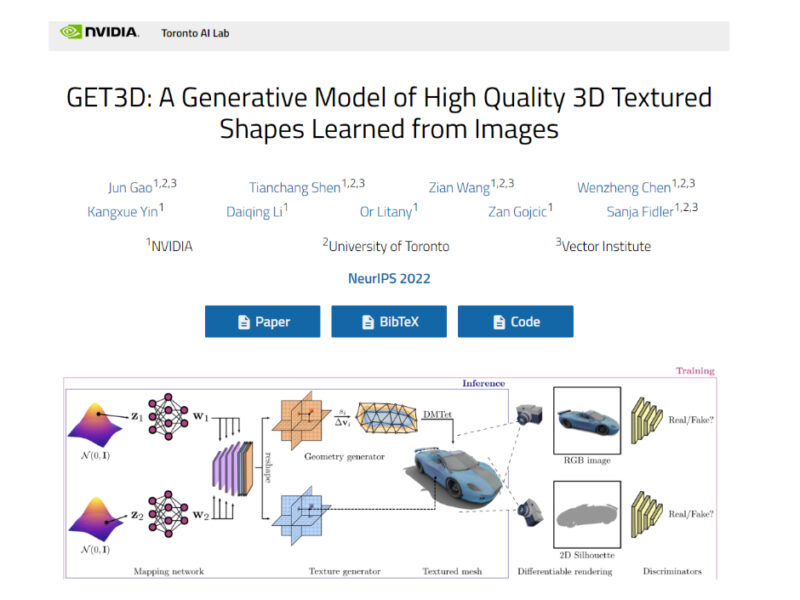
GET3D (Nvidia)
Introducing our exhilarating and captivating Generative 3D Textured Shapes from Images. Transform your visuals with …


Flythroughs
Our cutting-edge AI technology enables users to effortlessly produce stunning Flythroughs of professional quality using …


Explore Related Categories
Live Preview:
Updates automatically with live stats
Copied to clipboard!