GPT3 Playground
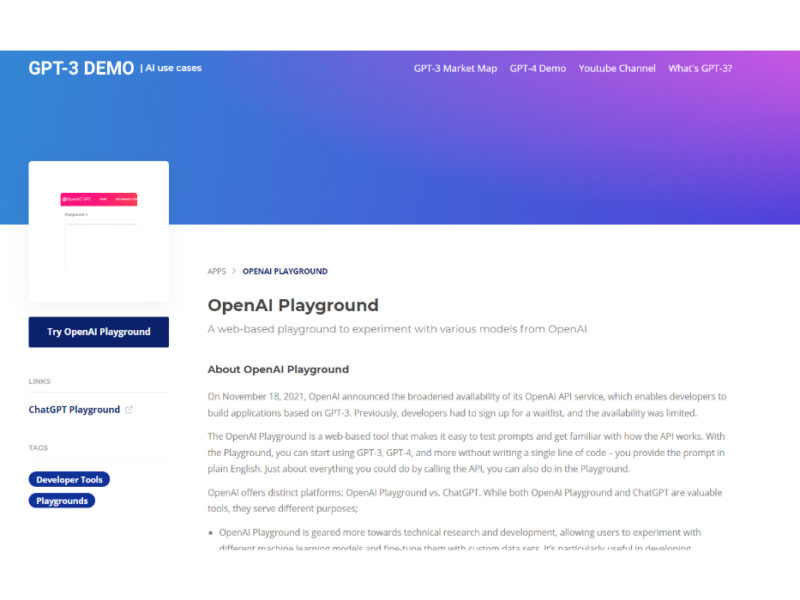
Discover the incredible potential of OpenAI’s GPT3 Playground, a dynamic and innovative platform that will leave you amazed. Unleash your creativity and explore the limitless possibilities by harnessing the power …
About GPT3 Playground
Use Cases
Use Case 1: Iterative Prompt Engineering for Developers
Problem: Developers often struggle to find the exact phrasing and parameter settings (like Temperature or Top P) required to make an AI model behave consistently within their own applications.
Solution: The GPT3 Playground serves as a technical sandbox where developers can experiment with "System" instructions and model parameters in real-time. This allows them to "stress test" prompts before hard-coding them into their software’s API calls.
Example: A developer building a legal-tech app uses the Playground to test if a model can summarize a contract without losing specific clauses. They adjust the "Frequency Penalty" to ensure the model doesn't repeat itself and set "Stop Sequences" to control the length of the summary.
Use Case 2: High-Volume Content Repurposing for Marketers
Problem: Marketing teams often have long-form assets (like webinar transcripts or blog posts) that need to be sliced into various social media formats, which is a time-consuming manual task.
Solution: Marketers can use the Playground to create a "content transformation station." By utilizing the larger context window and the ability to set a specific "System" persona, they can quickly turn one piece of content into dozens of social snippets.
Example: A marketer pastes a 2,000-word industry report into the Playground and uses the prompt: "Act as a social media manager. Generate 5 LinkedIn posts, 3 Twitter threads, and 10 SEO-friendly meta-descriptions based on this text."
Use Case 3: Zero-Shot Data Classification for Businesses
Problem: Small to medium-sized businesses often have disorganized data, such as customer feedback or support tickets, but lack the budget or expertise to build custom machine-learning classification models.
Solution: The Playground allows non-technical users to perform "Zero-Shot" classification, where they provide the AI with a list of categories and ask it to sort data instantly without any prior training.
Example: An operations manager pastes 50 recent customer support emails into the Playground and asks the model to "Classify these as: Urgent, Feature Request, or Billing Issue," then exports the organized list to a spreadsheet.
Use Case 4: Tone and Style Adjustment for Content Creators
Problem: Writers often struggle to adapt the "voice" of their writing for different audiences (e.g., turning a technical manual into a friendly "how-to" guide).
Solution: Content creators can use the Playground to rewrite existing text by defining a specific persona in the System instructions. The tool’s ability to follow complex stylistic cues makes it more effective than basic chat interfaces.
Example: A technical writer takes a dry, jargon-heavy software update log and uses the Playground to "Rewrite this for a non-technical audience of retirees, focusing on clarity, warmth, and step-by-step instructions."
Use Case 5: Prototyping AI Logic for Product Managers
Problem: Before committing engineering resources to a new AI feature, product managers need to prove that the AI is actually capable of solving the specific user problem.
Solution: GPT3 Playground acts as a low-code prototyping tool. Product managers can build a "proof of concept" by manually testing edge cases and showing the results to stakeholders to justify the development spend.
Example: A PM at a travel company tests whether GPT-3 can accurately calculate a multi-stop itinerary based on natural language input ("I want to go from London to Paris, then to Berlin, staying 2 days in each"). Once the PM proves it works in the Playground, they hand the prompts over to the engineering team.
Similar Tools You Might Like
Discover more tools in the same category
GitMind AI
GitMind is a dynamic and free collaborative mind-mapping software that serves as a powerful tool …

Product Manager OS
Product Manager OS is a comprehensive AI-powered toolkit specifically crafted for Product Managers, designed to …
Supermanage AI
Supermanage AI is an innovative tool leveraging AI to revolutionize the managerial experience. It focuses …
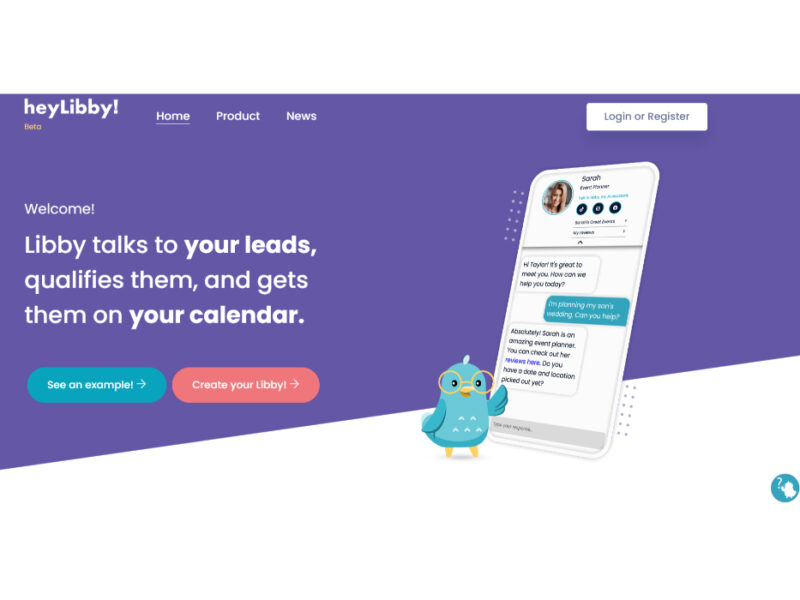
Heylibby.ai
HeyLibby! is a dynamic lead qualification and scheduling tool designed to streamline the lead management …
Live Preview:
Updates automatically with live stats
Copied to clipboard!