Creaitor AI
Creaitor.ai is an AI-powered writing tool that significantly enhances the writing experience for users. It integrates Cookiebot, a robust cookie consent management tool, ensuring compliance and efficient handling of user …

About Creaitor AI
Use Cases
Use Case 1: Scaling Organic Traffic with Automated Topic Clusters
Problem: Marketing teams often spend days manually researching keywords and grouping them into "topic clusters" to build search engine authority. Without a cohesive strategy, content remains fragmented, making it difficult to rank for competitive terms.
Solution: Creaitor AI’s "Topic Clusters" and AI Agents automate the heavy lifting. The tool identifies high-potential keywords and instantly organizes them into clusters, ensuring that every blog post supports a central pillar page for maximum SEO impact.
Example: A SaaS startup wants to rank for "Project Management Software." They use Creaitor to generate a cluster of 15 related sub-topics (e.g., "agile workflows," "remote team collaboration"). The AI Agents then draft the articles, ensuring each one hits the "SEO Score" target before the team schedules them via the built-in Content Planner.
Use Case 2: Multi-Brand Voice Management for Digital Agencies
Problem: Content agencies managing multiple clients often struggle to maintain distinct brand voices. A writer might accidentally use a "professional" tone for a client that requires a "playful" persona, leading to extensive revisions and brand inconsistency.
Solution: Creaitor’s "Brand Hub" allows users to create and store specific brand profiles. This ensures that the AI-generated content—whether it's a blog or a social media post—automatically adheres to the unique tone, style, and vocabulary of the specific brand assigned to that project.
Example: An agency manages a luxury skincare brand and a budget fitness app. By switching profiles in the Brand Hub, the agency can use Creaitor to generate an Instagram caption for the skincare brand that sounds elegant and minimalist, then immediately switch to a high-energy, motivational tone for the fitness app’s blog post.
Use Case 3: Future-Proofing Content for AI-Search (GEO)
Problem: Traditional SEO is no longer enough. With the rise of AI-powered search engines like Perplexity and ChatGPT (Search), businesses are losing traffic because their content isn't being "surfaced" in AI-generated answers.
Solution: Creaitor incorporates "Generative Engine Optimization" (GEO). It analyzes what AI models look for when sourcing information and helps users craft content that is specifically designed to be cited in AI search results, as well as traditional Google SERPs.
Example: A financial consultancy uses the "Optimize for SEO + GEO" feature to refine their guide on "Tax Laws 2024." Creaitor suggests specific data points and structuring techniques that make the content more "crawlable" for AI agents, increasing the likelihood that ChatGPT will cite the consultancy when a user asks about tax changes.
Use Case 4: Streamlining the "Research-to-Publish" Workflow for Solo Creators
Problem: Content creators often juggle four or five different tools: one for keyword research, one for writing, one for image generation, one for SEO analysis, and another for social media scheduling. This "tool fatigue" leads to lower productivity.
Solution: Creaitor centralizes the entire lifecycle in one platform. It includes an image generator, SEO scoring, an AI writer, and a native Content Planner that publishes directly to social channels and blogs.
Example: A solo blogger researching "sustainable travel tips" uses Creaitor to find keywords, generates a high-quality featured image using the built-in Image Generator, writes and optimizes the post to an 80+ SEO score, and schedules it to go live on their WordPress site and LinkedIn simultaneously—all without leaving the Creaitor dashboard.
Key Features
- AI-driven automated task agents
- Integrated SEO and GEO optimization
- Multi-brand voice and tone management
- Automated cross-channel content scheduling
- Instant AI-generated keyword topic clusters
- Real-time data-backed SEO scoring
- Competitive SERP insight analysis
- Performance-based content impact analytics
Similar Tools You Might Like
Discover more tools in the same category


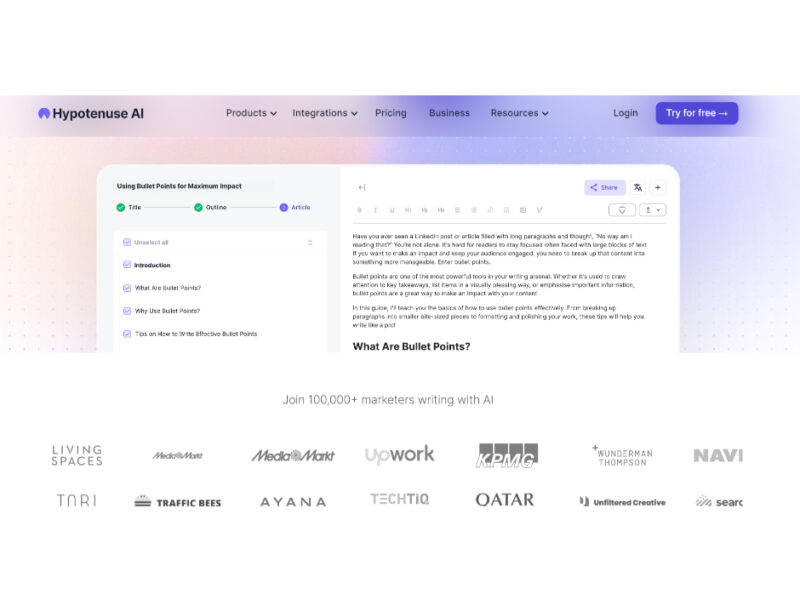
Hypotenuse ai
Hypotenuse AI is a state-of-the-art AI Writing Assistant and Text Generator designed to streamline and …
Explore Related Categories
Live Preview:
Updates automatically with live stats
Copied to clipboard!