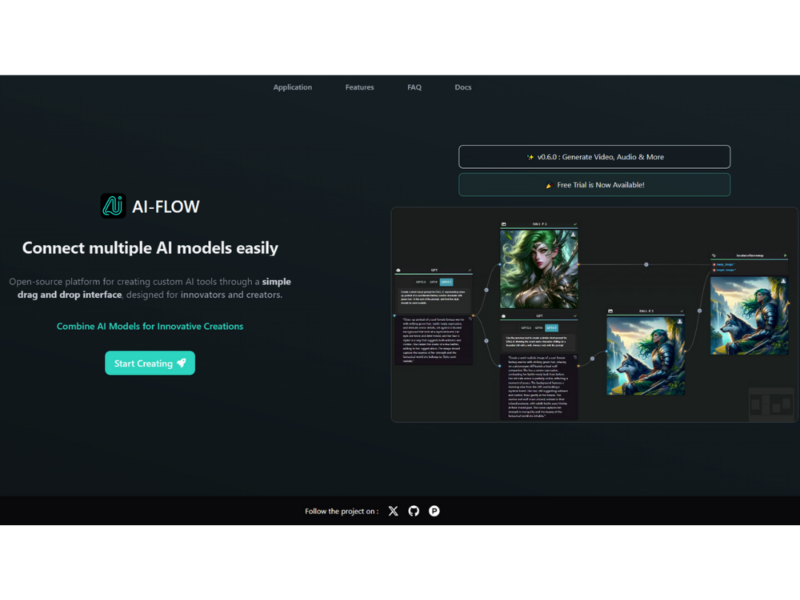
About AI-Flow
Use Cases
Use Case 1: Automated Multi-Channel Marketing Campaigns
Problem: Marketing teams often struggle to maintain consistency between ad copy and visual assets when scaling campaigns across different platforms, leading to high production costs and slow turnaround times.
Solution: AI-Flow allows marketers to create a single workflow that generates both text and imagery simultaneously. By chaining a high-end text model (like GPT-4.1) for copy with an image generation model (like FLUX.1.1 Pro), users can ensure that the visual style matches the tone of the written content within one interface.
Example: A user inputs a product description into the workflow. The flow branches out to GPT-4.1 to generate three different Instagram captions and simultaneously sends the prompt to FLUX.1 to create matching high-resolution product photography.
Use Case 2: AI-Powered Storyboarding and Illustrated Content
Problem: Content creators and authors who want to produce illustrated stories or e-books often lack the artistic skills or the budget to hire a full-time illustrator for every chapter or scene.
Solution: Using the "Write & Illustrate Stories" capability, creators can build a drag-and-drop sequence where a narrative model (like Claude 4) generates story segments, which are then automatically fed into specialized image nodes (like "Portrait Series - FLUX.1") to maintain stylistic consistency across the project.
Example: An author inputs a plot outline. AI-Flow generates the chapter text using Claude 4 and uses the output to trigger the "Seedream 4" node to create a series of consistent atmospheric illustrations for each chapter.
Use Case 3: Rapid Development of Custom AI Microservices
Problem: Developers and businesses often need specific AI functionalities (like face swapping or web summarization) integrated into their own apps but don't want to build complex backends or manage multiple separate AI provider APIs.
Solution: AI-Flow acts as an "API Builder." Developers can design a complex workflow using various models (OpenAI, Anthropic, Replicate) and then expose that entire flow as a single, custom API endpoint or webhook to be integrated into their existing software.
Example: A developer creates a flow that takes a YouTube URL, uses a summarization node to extract key points, and then uses GPT-o3 to format those points into a JSON file. They then integrate this single AI-Flow API into their company's internal research dashboard.
Use Case 4: Automated Video and Audio Content Repurposing
Problem: Businesses produce a large amount of video content (webinars, meetings, tutorials) that remains underutilized because it is time-consuming to manually summarize or convert into different formats.
Solution: By connecting YouTube summarization nodes with audio generation models (like Google Lyria 2), users can automate the conversion of long-form video content into concise audio summaries or even new musical backgrounds for short-form clips.
Example: A user connects a "Summarize YouTube Content" node to the "Lyria 2" music generator. The workflow extracts the core message of a business webinar and generates a short, upbeat audio summary with background music for the company’s internal podcast.
Key Features
- Drag-and-drop workflow builder
- Multi-model AI orchestration
- Custom API and webhook generation
- Local and cloud deployment options
- Personal API key integration
- Multi-modal content automation
Similar Tools You Might Like
Discover more tools in the same category
GitMind AI
GitMind is a dynamic and free collaborative mind-mapping software that serves as a powerful tool …

Product Manager OS
Product Manager OS is a comprehensive AI-powered toolkit specifically crafted for Product Managers, designed to …

Supermanage AI
Supermanage AI is an innovative tool leveraging AI to revolutionize the managerial experience. It focuses …

Heylibby.ai
HeyLibby! is a dynamic lead qualification and scheduling tool designed to streamline the lead management …

Explore Related Categories
Live Preview:
Updates automatically with live stats
Copied to clipboard!