AI Collective
Unleash the Power of Multiple AI Models: AI Collective is an innovative tool that offers unparalleled access to a variety of AI models, making it a powerhouse for generating diverse …

About AI Collective
Use Cases
Use Case 1: Professional Development for Clinical Teams
Problem: Healthcare organizations are rapidly adopting AI-driven tools, but clinical staff (such as pharmacists and nurses) often feel overwhelmed or intimidated by the technical jargon, leading to low adoption rates or misuse of the technology.
Solution: AI Collective serves as a structured educational "Roadmap" that translates complex technical concepts into a clinical framework. It helps staff understand the "Framework" of AI—inputs, algorithms, and outputs—without needing a computer science degree.
Example: A Lead Pharmacist at a hospital uses the "Part I: Start Here" modules to host a monthly workshop. They use the "Algorithm Learning Styles" section to explain to the team why a new predictive dosing tool requires "supervised learning" from historical patient data to be accurate.
Use Case 2: Vetting AI Software Vendors for Healthcare Businesses
Problem: Healthcare business owners and decision-makers are frequently pitched "black box" AI solutions by vendors, making it difficult to assess the clinical utility, safety, or regulatory compliance of the product.
Solution: By utilizing the "Part IV: Why Transparency Matters" and "Part II: AI in Healthcare" sections, decision-makers can develop a vetting checklist based on the concepts of interpretability and explainability.
Example: A pharmacy chain owner is evaluating an AI tool for inventory forecasting. Using the AI Collective’s framework on "Inputs" and "Outputs," they ask the vendor specific questions about what data types (structured vs. unstructured) the model uses and how it ensures "transparency" when a stock-out prediction is made.
Use Case 3: Developing Internal AI Governance and Safety Policies
Problem: Medical startups and clinics often lack a clear strategy for the "stewardship" of AI, risking unintended consequences or regulatory scrutiny regarding data bias and patient representation.
Solution: AI Collective provides a blueprint for "Part III: Policy, Regulations, and Standards." It guides organizations through the necessity of "active surveillance" and "diversity" within AI models to ensure the tools benefit all patient populations.
Example: A digital health startup’s compliance officer uses the "Creating A Strategy" section to draft their internal AI Ethics Charter. They incorporate the tool's guidance on "promoting public trust" and "minimizing regulation where possible" to balance innovation with patient safety.
Use Case 4: Educational Content Creation for Health-Tech Marketers
Problem: Marketers and content creators in the health-tech space often struggle to explain their AI products in a way that resonates with healthcare professionals who are skeptical of "buzzwords."
Solution: AI Collective offers a "Shared Language" and high-level overviews that marketers can use to bridge the gap between technical specs and clinical application.
Example: A marketing manager for a new diagnostic AI app uses the "Short and Sweet on AI" and "Interpretability vs. Explainability" sections to write a series of whitepapers. These papers explain the app's value in a language that clinicians understand, focusing on how the model "thinks" rather than just its accuracy percentages.
Key Features
- Pharmacy-focused AI educational roadmap
- Curated healthcare AI resource directory
- Clinical AI utility frameworks
- Healthcare-specific AI policy guidance
- Algorithm learning style education
- Model interpretability and explainability lessons
- Structured healthcare data input tutorials
Similar Tools You Might Like
Discover more tools in the same category
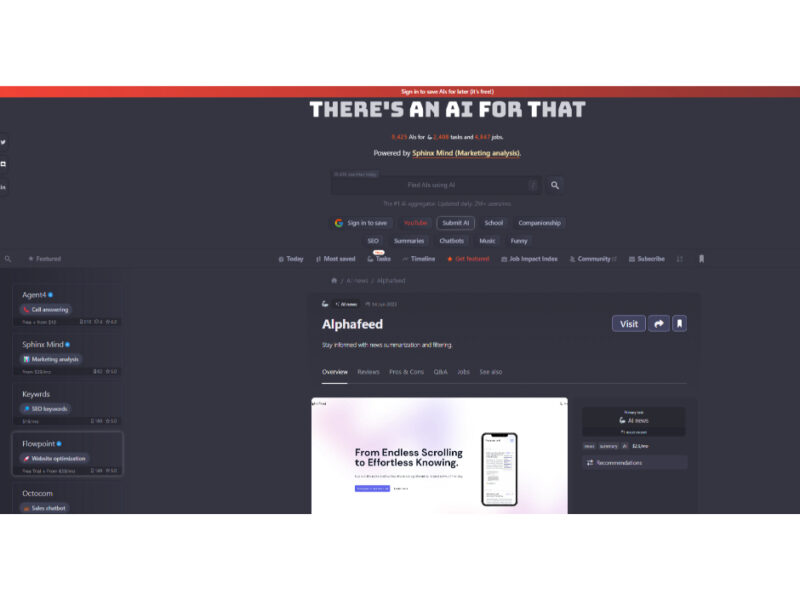
Alpha Feed
Introducing Alpha Feed: Your Premier Source for AI News: Alpha Feed is a trailblazing tool …

Explore Related Categories
Live Preview:
Updates automatically with live stats
Copied to clipboard!